Living an adapted life through carpentry
In my teens, I discovered my love of carpentry. It was logical to me, and at the end of the day, I would have a tangible product.
With the few dollars I could scrape together at the time, I bought my first drill. A corded Makita.
Through my late teens and 20s, I would often move to places where some rudimentary carpentry was needed. I would plan, assemble materials, and build. Not fine carpentry. More functional creations that if you looked very carefully, showed promise.
At the end of graduate school, I accepted a co-op term in a beautiful town in central/northern British Columbia called Smithers. I was going to live in a house with two roommates, but they hadn’t arrived yet. The house was empty.
I went to the local hardware shop and bought some lumber, hardware, and other supplies. Using my circular saw, drill, and hammer, I built a coffee table and a desk where I would write the last 20% of my Master’s thesis. The table was built from dimensional lumber, 2 x 4s and 1 x 6s. I was quite impressed with my work, but there was at least one obvious flaw with the desk: a gap between the boards on the writing surface. Every now and then, the pencil I was using to handwrite the draft of my thesis would puncture the paper as it went through the gap.
My furniture served its purpose. But as I was leaving Smithers, I felt I had left a legacy of bad furniture for future co-op students in northern British Columbia.
When I returned to Vancouver and then eventually moved to Victoria, I took a series of carpentry courses through continuing education programs. After work, in these evening classes, I learned how to use various carpentry tools. A biscuit joiner to attach two planks together. A planer to make boards a uniform thickness. A router to make curved edges.
I continued to assemble carpentry tools as a weekend warrior. When my dad visited my workshop at our first house, he asked, “whose tools are all these?” When I told them they were mine, he said, “you know how to use ALL of these?” In his working life, my dad was a brilliant engineer. Bridges, Sky Train, industrial facilities. Hearing his amazement at my tangible, self-taught skills made me proud.
During my first decade with Multiple Sclerosis (MS), my manual dexterity declined, lessening my ability to do carpentry safely. While I respect that damage occurred to my body because we didn’t yet have the medications needed to fight MS, I am occasionally annoyed that I can’t use the tools I carefully assembled to do carpentry. So much thought went into choosing the right tools, purchased with the hard earned money I squirrelled away. Unfair really. Add it to the list of my past hobbies that MS stole. Soccer. Hiking. Carpentry.
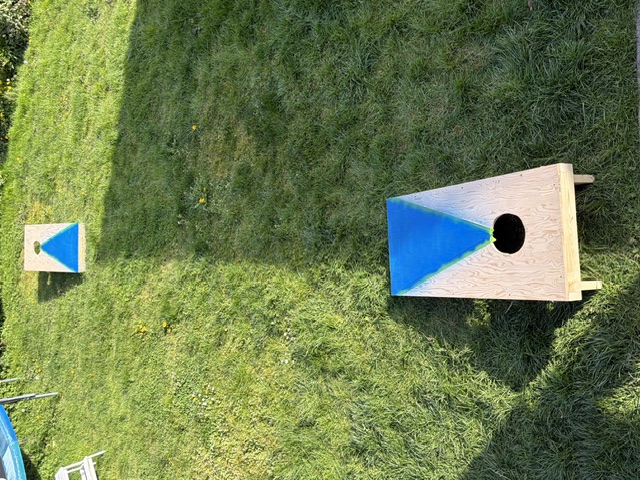
A couple of weekends ago, as spring returned, I decided that I would like to play the beanbag toss game in the backyard with my family. Always such lively entertainment among my mildly competitive, athletic family. (Okay, maybe really competitive family).
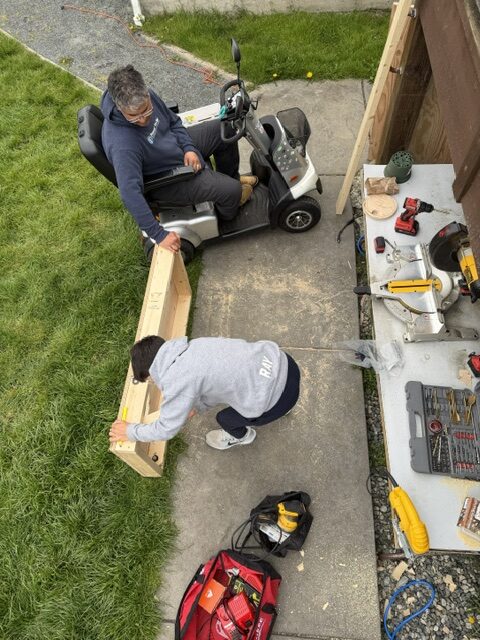
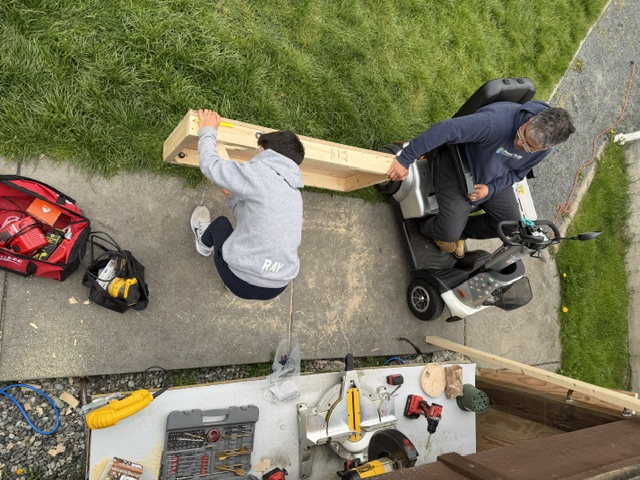
I thought instead of buying the game from a big box store and likely having to replace it next year when it fell apart, I would build the game myself. Using my hands, I would dust off my tools. The angles would be different working from my wheelchair. Moving an eight foot 2 by 4 would be difficult. But I thought I could grind through it.
My whole family went to the local hardware store. My wife, three kids, exchange student, and me. I explained what we were building to the staff. Each person in the store showed real enthusiasm as this motley crew described their project.
Perhaps most importantly, I saw my 13-year old son get actively engaged in the process. He listened as the fellow at the lumber yard described how he would cut the large sheet of plywood. Daniel selected straight 2 by 4s, and learned as the paint specialist described how to effectively apply spay paint. (The last teaching may be flagged as a bad parenting moment down the road. Time will tell.)
When we got home, the kids helped unload the vehicle. My son and I then got to work. The game required two wooden ramps. I laid out what we need to do to Daniel. Under my supervision, he cut the lumber, drilled pilot holes, screwed the cut pieces together, used my jigsaw to cut a hole in the plywood, sanded the final product, and spray painted an artistic design.
The next day we went about building the second box. This time, the amount of instruction I needed to give Daniel was minimal. He learned from building the first one to improve the second box.
Rather than being annoyed that I could no longer take on the carpentry projects that I used to love, I was now excited by the fact that I could transfer my knowledge to the next generation and watch him flourish, building confidence in his skills and self. Another unexpected outcome of this MS thing.
I was even happy enough not to be annoyed when I realized that Daniel will be a far better carpenter than I ever was. Let’s pretend it is due to good teaching, shall we?
Finding the points of light is a common theme in my adapted existence. They are there. I found one through carpentry. It wasn’t obvious before we started, but it was waiting to be found.
Leave a Reply